
What is it?
The QBO measures equatorial zonal winds that fluctuate between westerly (positive) and easterly (negative). These winds are measured in the tropical stratosphere, and they influence the tropospheric circulation. In turn, the QBO can affect the Northern Hemisphere pattern through disruptions of the polar vortex and the stratosphere.
An easterly QBO in winter is associated with a weaker, more easily disturbed polar vortex, known as the Holton-Tan relationship, which tends to favor high-latitude blocking. A westerly QBO tends to go with a stronger, more stable vortex.
More information is available from the Free University of Berlin’s atmospheric sciences division: QBO overview and data
Current QBO Data
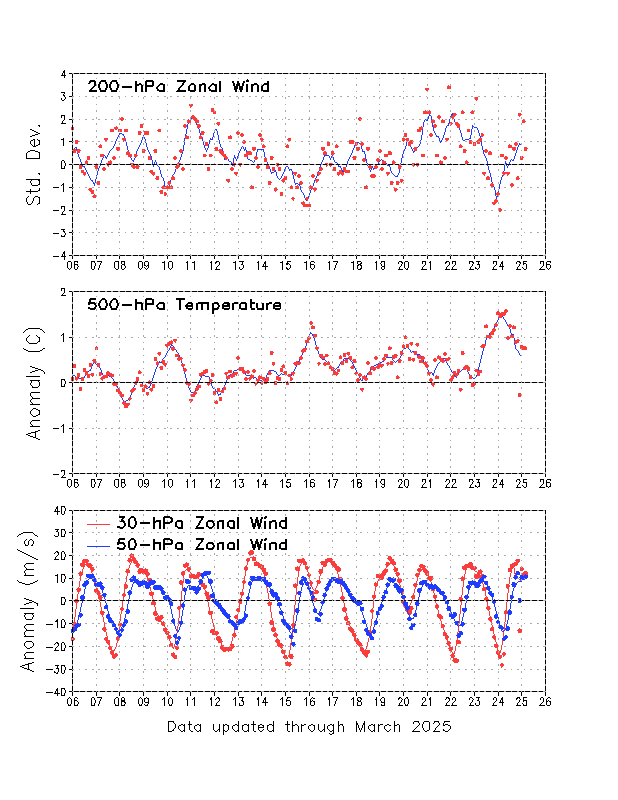
Monthly index values from the Climate Prediction Center: 30 mb zonal wind index and 50 mb zonal wind index.
It is important to note that positive numbers indicate westerly winds and a westerly QBO, and negative numbers indicate easterly winds and an easterly QBO. The QBO is highly cyclical and therefore more predictable than some other indices.
DJF Composites

Source: New England NAO

East and West QBO with ENSO composites for NDJF

Source: AMS